Strategies
Hundreds of strategies, by theme.
Our central AI runs research and risk across every one of them, every day. You choose which run on your exchange accounts, and at what size. Every month we release a new set, each one tested internally, then on paper, then live by the team. If you need something the library does not cover, we will add it to our research pipeline.
Example themes.
Each strategy sits in one or more themes: the markets it trades, or the story those markets share. Some examples.
Digital assets
- CryptoBitcoin, ether, and other digital assets, in spot, perpetual futures, and options.
- Tokenized equityShares issued as tokens and traded on crypto venues, often around the clock.
- Crypto-linked equityListed companies whose business moves with crypto: miners, exchanges, and bitcoin holders.
Equity
- US equityUS stocks, sectors, and indexes such as the S&P 500, the Nasdaq 100, and the Russell 2000.
- Intl equityDeveloped and emerging markets outside the US, by country and region.
- Semis / tech themesChipmakers, chip equipment, and the technology themes built on them.
- Infra / defense / transportInfrastructure builders, defense contractors, rail, shipping, and airlines.
- SpaceLaunch, satellite, and space-services companies.
- Clean energySolar, wind, batteries, and the grid.
Metals and commodities
- GoldGold, gold miners, and gold priced against currencies and other assets.
- SilverSilver and silver miners.
- Industrial metals / minersCopper, aluminium, nickel, lithium, and the companies that mine them.
- UraniumUranium miners, fuel suppliers, and nuclear power.
- EnergyCrude oil, natural gas, refiners, and producers.
- AgricultureGrains, softs, livestock, and the companies that supply farms.
Rates and FX
- Rates / creditGovernment bonds across the curve, and corporate credit.
- Rates / credit + FXBonds and credit traded together with currencies, such as rate gaps between two countries.
- FXCurrency pairs and the US dollar.
By strategy type.
The same library seen by how the strategies make money. Eight common types, as examples.
Statistical arbitrage
- Price relationship trading across correlated pairs
- Crypto spot and futures, equity single-names
- Cross-exchange venue arbitrage
- Cointegration-based entry, regime-conditioned exit sizing
Basis and funding rate
- Perpetual futures funding rate capture
- Spot-futures basis across multiple venues
- Cross-asset carry
- Regime-conditioned sizing: larger when funding is persistent
Mean reversion
- Single-asset reversion to moving averages
- Cross-asset spread reversion
- Volatility mean reversion
- Regime-gated: size down in trending conditions
Trend following
- Time-series momentum across crypto and equities
- Cross-sectional momentum within asset classes
- Multi-timeframe confirmation: short and long horizon aligned
- Regime-gated: size down in ranging conditions
Options
- Covered calls and cash-secured puts for yield on BTC and ETH holdings
- Protective puts and collars to hedge a crypto book
- Straddles, strangles, and spreads to trade volatility rather than direction
- Skew and term-structure trades across strikes and expiries
- Regime-conditioned: the balance between selling premium and buying protection follows the volatility regime
Volatility harvesting
- Systematic options strategies on Deribit
- Volatility risk premium capture in BTC and ETH
- Regime-conditioned position sizing
- Portfolio-level EVAR accounts for cross-strategy correlation
FX
- Carry: higher-yielding currencies against lower-yielding ones
- Trend and momentum across G10 and emerging-market currencies
- Value: currencies against rate and inflation-based fair value
- Dollar regime signals feeding crypto and risk-asset positioning
- Regime-conditioned: carry cut back as volatility rises
Rates and macro carry
- Interest rate carry across global markets
- Macro factor exposure: growth and inflation signals
- Crypto funding carry versus TradFi rates comparison
- Cross-asset regime indicators feeding into strategy weighting
Inside a strategy.
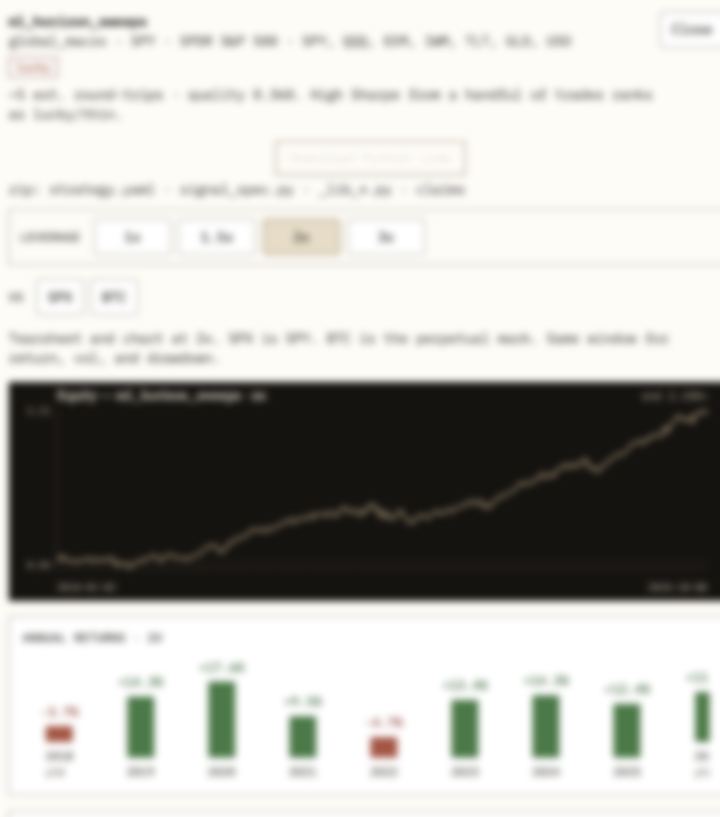
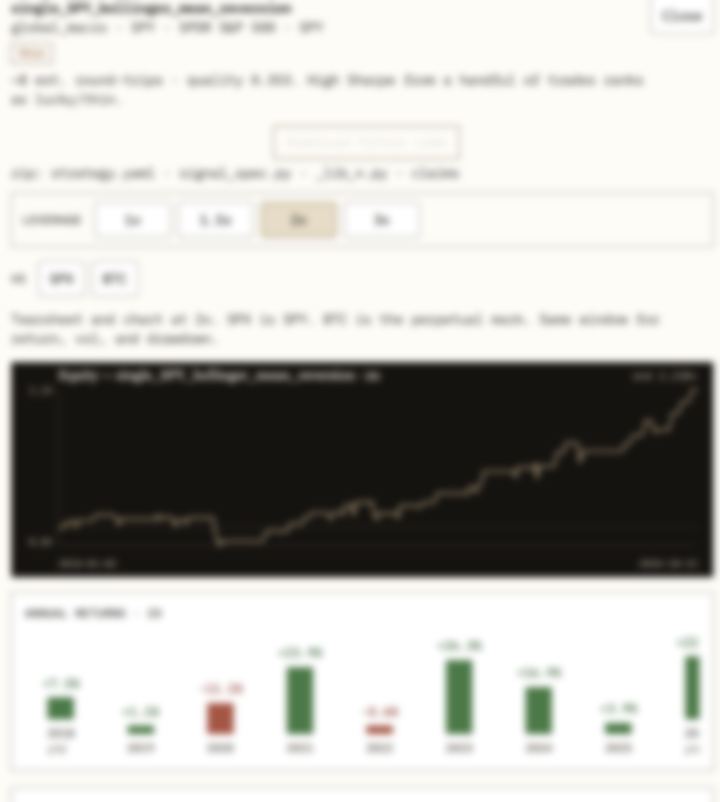
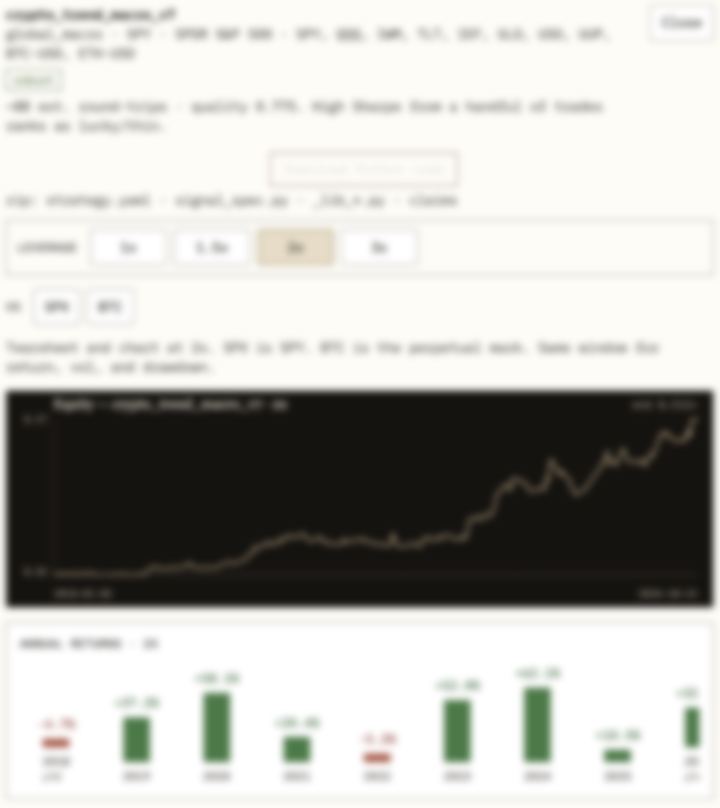
Every strategy has its own page: the instruments it trades, its code, the leverage you choose, and every trade its signal makes. Shown blurred here. We open real ones on the call.
How you use them.
Your own Hedgehog AI selects from the library, with you. Run it on paper first or go live straight away, and change allocations at any time. Size has two limits, and the smaller one wins: what you want to allocate, and the most that strategy can take. The strategies are enhanced as the market changes, and the changes reach your AI.
See the strategy types on the platform page →Book a 20-minute call.
We cover the research, how risk runs on your exchange accounts, and how onboarding works for you.